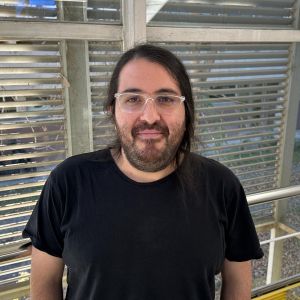
The first researchers participating in the IFAE Severo Ochoa Visitor Programme have now begun their stay at the institute. This programme supports short- and medium-term visits by leading international researchers, with the aim of strengthening ongoing collaborations and fostering new lines of work across experimental and theoretical particle physics, astrophysics, and cosmology.
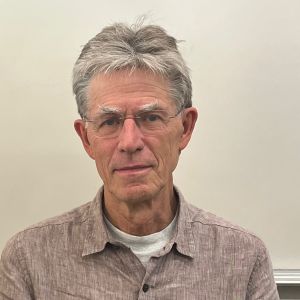
Severo Ochoa Visiting Fellow: Maarten Golterman
Prof. Maarten Golterman, from San Francisco State University, carried out a strategic research sabbatical at IFAE during the 2025–2026 academic year, strengthening a long-standing collaboration with Dr. Santiago Peris in the Theory Division.
An elected Fellow of the American Physical Society and a leading expert in Lattice QCD, Prof. Golterman currently serves as spokesperson of the Advisory Board of the Flavor Lattice Averaging Group (FLAG) and is a member of the international g−2 Theory Initiative.
His research at IFAE focused on the theoretical understanding of the muon anomalous magnetic moment, one of the most important open questions in particle physics. Together with IFAE researchers, he investigated the hadronic vacuum polarization contribution using hadronic tau decay data and Lattice QCD calculations. This collaboration has resulted in a new research paper currently in preparation.
Beyond his research contributions, Prof. Golterman delivered a series of five advanced lectures on Lattice QCD for master’s students and researchers, presented an IFAE Colloquium, and helped strengthen IFAE’s international network by facilitating visits from other leading theorists.
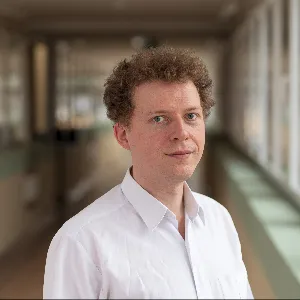
Severo Ochoa Visiting Fellow: Julian Sitarek
Prof. Julian Sitarek, from the University of Łódź (Poland), conducted a strategic research stay at IFAE focused on very-high-energy gamma-ray astronomy and multi-messenger astrophysics.
Prof. Sitarek currently serves as Scientific Coordinator of the MAGIC Collaboration and leads the Polish contribution to the Large-Sized Telescopes (LSTs) of the future Cherenkov Telescope Array Observatory (CTAO). His visit also marked a return to IFAE, where he had previously held a Juan de la Cierva fellowship.
Working with the IFAE Gamma-ray Astronomy group, he addressed the statistical combination of gravitational-wave alerts with very-high-energy gamma-ray observations. His work compared frequentist and Bayesian approaches through advanced Monte Carlo simulations, providing valuable tools for the interpretation of observations performed with the MAGIC and LST-1 telescopes. The collaboration has already resulted in a scientific publication currently in an advanced drafting stage.
During his stay, Prof. Sitarek also delivered an IFAE Colloquium entitled “Novae: a recent addition to the very-high-energy gamma-ray sky” and contributed to the training of researchers in advanced data-analysis techniques and source modelling.
Severo Ochoa Visiting Researcher: Antonio De Maria
Dr. Antonio De Maria, from Nanjing University (China), completed a three-and-a-half-month research stay at IFAE hosted by Dr. Imma Riu within the ATLAS Experimental Group.
An expert in Higgs boson physics and advanced detector trigger systems, Dr. De Maria collaborated closely with PhD students on tau energy scale measurements and energy correction factors. His expertise significantly contributed to activities within the Trigger Level Analysis (TLA) group, an area in which IFAE plays a leading role within the ATLAS Collaboration.
During his visit, he delivered a seminar on the ATLAS tau trigger system and a colloquium reviewing a decade of Higgs and Di-Higgs physics. His work contributed to an upcoming publication on tau trigger performance and future developments. In addition, he shared new identification algorithms and recommendations that have since been adopted as the default approach within ATLAS, leaving a lasting technical legacy for the collaboration.