The IFAE Severo Ochoa Mobility Programme supports research stays by PhD students, postdoctoral researchers and other early-career personnel at leading international centres and scientific facilities.
More than an opportunity to spend time abroad, each stay is designed around a clear scientific or technical objective: completing a research project with an international collaborator, learning a specialised experimental technique, accessing facilities or expertise not available locally, or developing skills that can later be transferred to IFAE.
The programme is part of IFAE’s broader Severo Ochoa strategy to expand the training and international networking opportunities available to its researchers. By supporting carefully targeted stays, it strengthens existing collaborations while opening new ones and helps young researchers develop the scientific independence, technical expertise and international connections needed for the next stages of their careers.
Recent stays illustrate the different ways in which this mobility programme can generate lasting impact.
Dounia Nanadoumgar-Lacroze: using DESI galaxy data for gravitational-wave cosmology at Glasgow
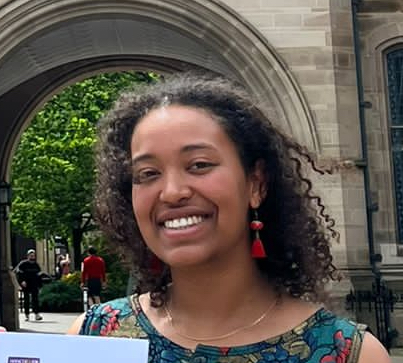
Dounia Nanadoumgar-Lacroze, from IFAE’s Gravitational Waves group, spent four weeks at the Institute for Gravitational Research at the University of Glasgow, working on the use of gravitational-wave detections to measure the expansion of the Universe.
The stay focused on improving the galaxy catalogues used in dark siren analyses, a method for determining the Hubble constant by combining gravitational-wave observations with information about the distribution of galaxies. Working with Dr. Rachel Gray, Nanadoumgar-Lacroze explored the use of the DESI Data Release 1 Bright Galaxy Survey, one of the largest and most complete spectroscopic galaxy catalogues currently available.
The work established the basis for using DESI’s precise spectroscopic redshifts to reconstruct the galaxy distribution associated with gravitational-wave events and test how different modelling choices affect the resulting cosmological measurements. The next steps include identifying well-localised gravitational-wave events within the DESI footprint and evaluating how much the new catalogue can improve constraints on the Hubble constant.
The stay has therefore opened a new avenue for combining two major areas of IFAE research — gravitational waves and observational cosmology — while laying the groundwork for further analysis and a potential dedicated publication.
Francesco Sciotti: advancing theoretical physics collaborations at Caltech and McGill
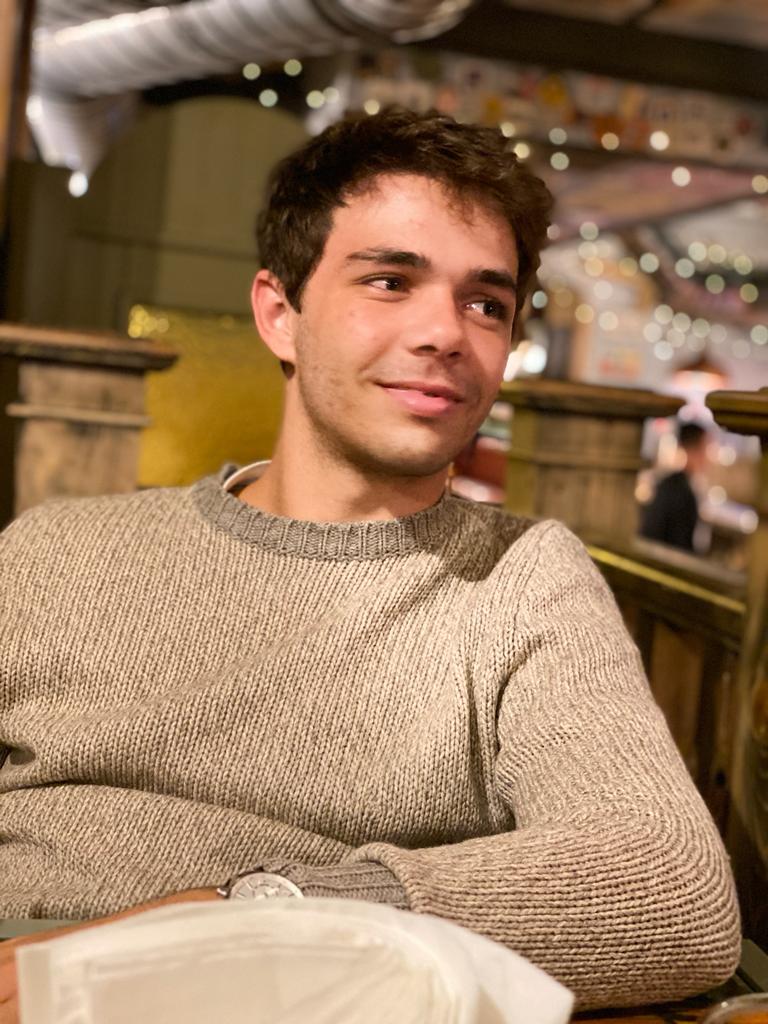
Francesco Sciotti, from IFAE’s Theory Division, carried out two consecutive research stays in North America, first at the California Institute of Technology (Caltech) and subsequently at McGill University.
At Caltech, Sciotti worked with Prof. Clifford Cheung and the Walter Burke Institute for Theoretical Physics on positivity bounds and scattering amplitudes in effective field theories. The visit contributed directly to the completion of the paper “Multipositivity Constrains the Chiral Lagrangian” and provided the starting point for new related projects. During the stay, he also presented the seminar “Higher Point Positivity and Large Nc QCD”.
He then continued this research line at McGill University with Prof. Simon Caron-Huot, a leading expert in scattering amplitudes and dispersive positivity bounds. The stay initiated a new collaboration on positivity constraints in effective field theories.
Together, the two visits show how focused mobility can consolidate an existing research project while creating the connections from which the next ones emerge.
Guillermo del Riego Ruiz: transferring quantum technology expertise from KIT to IFAE
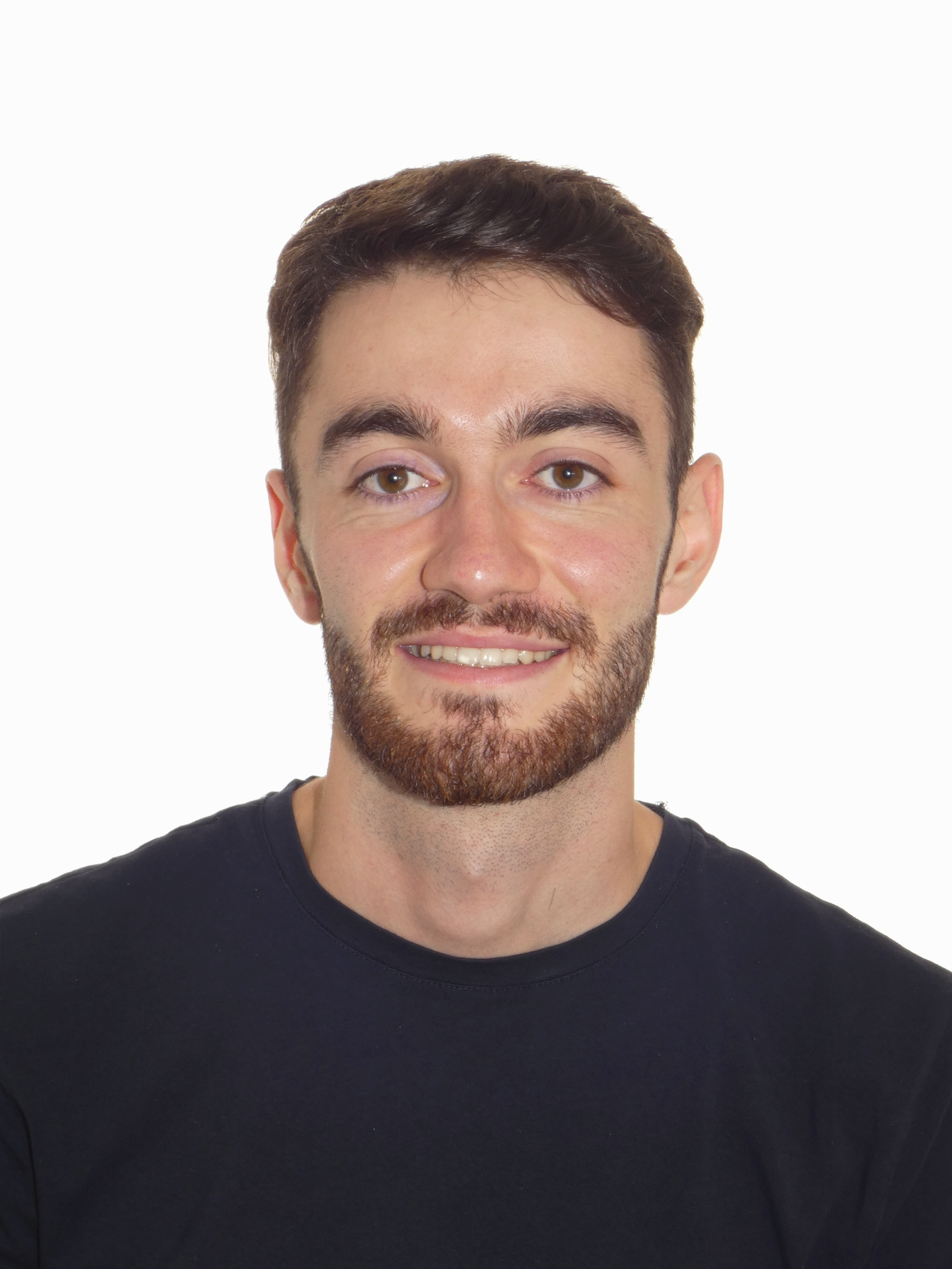
Guillermo del Riego Ruiz, from IFAE’s Quantum Computing Technologies group, spent one month at the Karlsruhe Institute of Technology (KIT) working with Prof. Ioan M. Pop and the Institute for Quantum Materials and Technologies.
The main objective was to test the first superconducting flux qubits fabricated at IFAE for use in a flip-chip architecture, using KIT’s established experimental platform. The stay also provided hands-on training in the design, fabrication and operation of the setup, with the longer-term goal of implementing similar capabilities at IFAE.
The visit produced immediate results. A fabrication issue affecting the performance and reproducibility of the IFAE devices was identified and, working together with the KIT team, a revised fabrication process was developed. A new batch of qubits was subsequently fabricated with significantly improved performance.
Del Riego also returned to IFAE with newly fabricated devices, a prototype chip enclosure and the expertise required to perform continuous-wave and time-domain measurements independently. The stay therefore combined training with a direct transfer of technology and know-how to IFAE’s growing quantum-computing infrastructure.
Jam Sadiq: building gravitational-wave computing expertise at Georgia Tech and Caltech
Jam Sadiq undertook a one-month specialised training and research stay focused on high-throughput computing for gravitational-wave research, combining participation in Throughput Computing Week in Wisconsin with extended work at Georgia Tech and the LIGO Laboratory at Caltech.
The programme began at Throughput Computing Week 2026 in Madison, where he engaged directly with the developers and maintainers of HTCondor and explored the latest developments in technologies including Pelican and the OSPool.
At Georgia Tech, working with James Clark and Peter Couvares, the focus shifted to the use of these technologies within gravitational-wave astrophysics. Sadiq received specialised training in HTCondor and the International Gravitational-Wave Observatory Network computing infrastructure, covering job automation, resource management, Pelican, GlideinWMS and the IGWN computing pool.
The final stage took place at the LIGO Laboratory at Caltech, where, working with Stuart Anderson and his team, he applied this knowledge to several hands-on projects. These included deploying a GitLab instance with automated CI/CD workflows, developing a prototype containerised execution point for HTCondor jobs, and using Kubernetes to perform rapid checks of gravitational-wave posterior data.
The stay combined advanced technical training with the development of working computing tools and direct interaction with the HTCondor and LIGO communities. The expertise acquired can now be transferred to IFAE, supporting larger and more automated gravitational-wave analysis workflows and strengthening the institute’s computing capabilities in this field.
Bringing expertise back to IFAE
The value of these stays extends beyond the individual researchers who take part. New methods, technical expertise, software, prototypes and scientific collaborations return with them to IFAE, strengthening the institute’s research groups and creating opportunities for further joint work.
This multiplier effect is central to the Severo Ochoa Mobility Programme: supporting carefully chosen international experiences that can make a concrete difference to a research project today while helping build IFAE’s scientific capabilities and collaborations for the future.